
Sky: Children Of The Light – Atlas Chen Discusses thatgamecompany’s Latest Release
“Under the sky, under the heavens, there is but one family.”

Thatgamecompany has achieved a legendary reputation following 2012’s Journey, a game that was a calm refutation of the industry at large. A few eyebrows were raised when it announced that its next game, Sky: Children of the Light, would release on mobile devices only, at least at first. The Indie Game Website sat down with Atlas Chen, Game Designer at thatgamecompany, to chat the ins and outs of development, as well as how Sky came to be.
There are remnants of your other games, namely Journey and Flower, in Sky. What did you try to do different when developing the game compared to your earlier titles? Was there a particular design goal you really wanted to achieve?
I joined thatgamecompany (TGC) during the development of Sky but I didn’t work on previous titles. However, I did study TGC’s games intensively during the thesis for my MFA in Game Design. From my perspective, Sky, while being a spiritual successor of TGC’s previous titles with the core of bringing positive inspiration to people, is something quite unique. From Flow, Flower, Journey to Sky, I see a continuously increasing emphasis on humanity, on people, on the players. In Sky, we are inspired to create a lasting community, a pure land that fosters genuine friendship, love, and compassion.
“Under the sky, under the heavens, there is but one family,” Bruce Lee said. If we can truly see that everyone is family, if there is no enmity, no hatred, no separation from the concept of ‘you’ and ‘me,’ what would the world become? I hope Sky will give us a peek of that.
How was the experience of releasing a prologue/beta – Sky: Light Awaits – before the full game? Was there any specific feedback from that which influenced the finished project?
It was immensely helpful. Sky is a very unique and experimental project. We didn’t know the answer to many questions until we were able to test it for real. The beta testers provided us with invaluable input and data. It significantly helped us shape the economy system, social interaction, as well as the learning and onboarding experience for new players.
We receive a large amount of feedback for every iteration. People write very detailed reports about things they see can be improved. They take screenshots and videos for the problems they have seen. They discuss with each other and give us thoughtful suggestions. There were also many fanarts and comics created by them that have brightened our days.
It feels that the beta players have been working side by side with us and they really believe in us and care for our success. We deeply appreciate the devotion of our beta players and we will continue listening to all our players and making Sky better as the world will continue to evolve.
How do you think an initial mobile release will evolve the shared-world multiplayer you established in Journey? The whole multiplayer aspect seems to be more ambitious.
Both Journey and Sky are very unique. To me, Journey emphasizes more the inward reflection of one’s experience. The multiplayer connection is more metaphorical – since you won’t meet the person again, it becomes a symbolic figure to contemplate on. Sky provides a much more direct way of interaction and communication and lasting bonds with your friends. If Journey is a pilgrimage with strangers to a shared destination, Sky is a home for one big family to return to.
Another aspect is that Sky is very different, in that it is a living and breathing world. This is also quite new and exciting to us. The world of Sky will continue to evolve after the initial launch. And we will continue to listen to the community. The players, previously beta testers and now players from all over the world, will be shaping the world of Sky with us together.
Have there been any hints or surprises in how players have responded in Light Awaits?
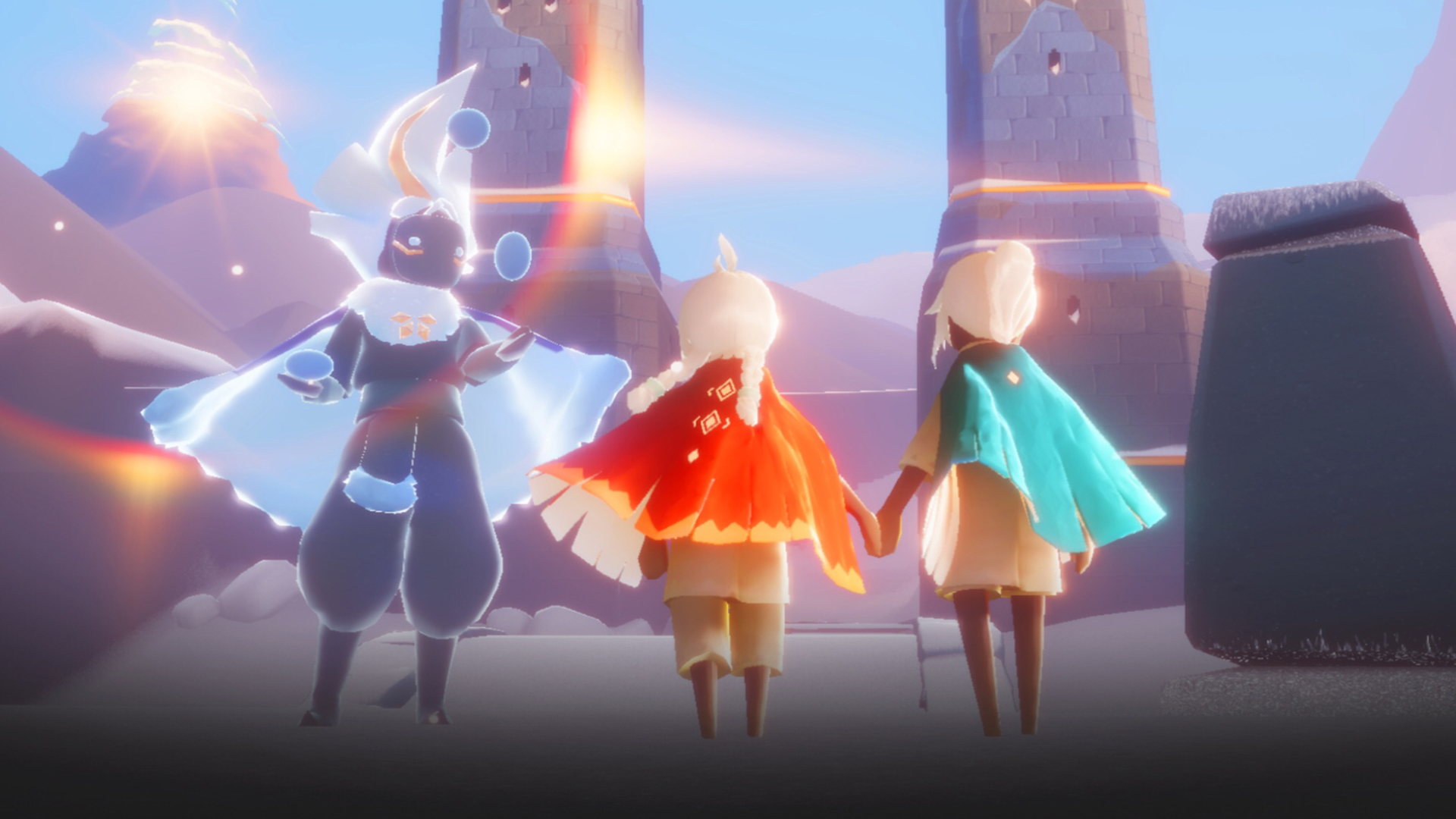
In the game, there are many examples of etiquettes. Most friends I have met in the game always say goodbye to me before they leave, by using emotes like a wave, bow, hug, or an air kiss. When I log into the game and meet an old friend, they would often offer me a hug. When I have tried to play music in the game, there are many times that even strangers would clap or dance for me. It’s great to see such a synergy with people I have just met.

From the developer’s side, it is also wonderful to see that the community has been very supportive and caring for us. Even when they are reporting bugs and complaints most people are polite and encouraging.
While Flower was eventually ported to iOS, Sky: Children of the Light is your first proper mobile game. How has designing a game from the ground up for mobile? Have there been any unique challenges you didn’t quite expect?
From a game design perspective, a major challenge has been usability. How we make the control scheme intuitive and easy to use has been a great challenge. Teaching that control scheme has also been another. Since the player could block part of the screen, UI design and level design has required specific attention to configuration too… and we have had to ensure important information is easy to read.
Certainly, the user base for mobile has been more varied and we aspire to create a game that every member of a family can play together. It was crucial (although challenging) to cater to people of different gaming experience and skills. There was also tremendous work from the engineering team to bring a console-quality experience to mobile. We are excited to see what fans make of it on mobile.
Have there been any changes you’ve had to make to the game’s design due to its free-to-play model?
After years of experiments, free-to-start revealed to be the right choice since we want to reach to a larger audience and make a bigger impact on both the gaming industry and society.
There were many design implications after this decision. For example, retention and replayability became important aspects. This required a lot more content to be built, along with new replayable game mechanics for each part of the world. In-game purchases also meant we needed a whole economy system too.
To foster a positive community and live up to what we think is right, we have been very cautious. It may seem naive from a business standpoint, but we have implemented mechanics to discourage people from spending unhealthily long hours in Sky. We have also tried to avoid adding mechanics for meaningless chores in the world or for selfish grinding – just for the sake of retention or replayability. What players do in Sky must be meaningful in order to help the people in the world and other players.
How has the communication and relationship with Apple been since the game’s big announcement at the company’s 2017 keynote?
As both the developer and publisher of Sky, we have been thankful for Apple’s support and promotion to ensure Sky is in the hands of as many players on their devices as possible. All of our platform partners have been great in supporting us as we look to release Sky on Android, PC and console in the near future. Our hope is as many people play Sky as possible and fall in love with video games as a medium like we have.
All in all, what is your proudest achievement with Sky?
It might be too early to say what we have achieved yet. But I’m really proud that as a team we have stayed true to ourselves and have always intended the best for our players. There were times where the direction looked too distant, and there were times where we struggled with challenges, but we never forget why we started.
I truly believe that we strive to do something meaningful for the players, for the gaming industry, and for our society. It’s beautiful to see that players from all over the world are holding hands together and experiencing the wonders in the world of Sky together.
Despite moving to a smaller device, it appears thatgamecompany has preserved the scale of its charms. Sky: Children of the Light is now available on iOS.