

Blake: The Visual Novel Review
Normally I’d start with a brief synopsis of the game’s characters, story, and central conflict, but Blake: The Visual Novel has left me struggling to summarise it all, because so much of the visual novel feels like loosely connected strands of plot or character exposition with little follow-through or fleshing out.
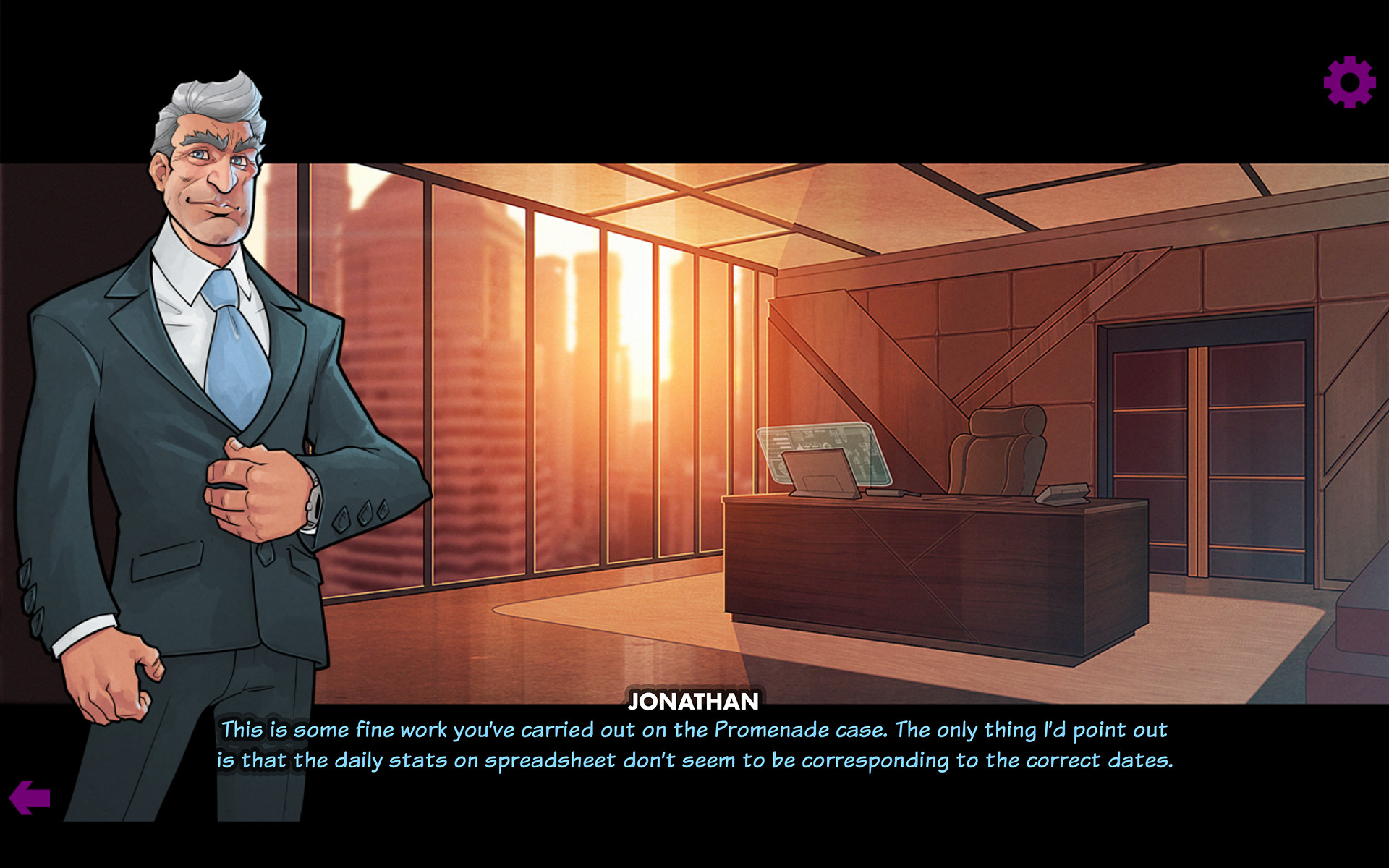
I can safely say the game focuses on our titular character, Blake, muddling through an increasingly confusing and bloody part of his life, but beyond that it’s a bit messy. The story begins with Blake standing on the edge of a rooftop, waking up from a dream, and then going to work. Then he gets to the office and finds out that the boss wants to have him work on a secret pseudo-VPN project, suggesting that the game might be delving into a tech-gone-wrong storyline.
But then there’s a sudden revelation about Blake’s family, a max security prison reality show, a kidnapping, and so many other twists and turns that eventually it becomes impossible to really define Blake: The Visual Novel, and I do not mean that in a positive way.
Hit and run
My first run took 74 minutes, and left me with the distinct impression that the story would have been better told over the course of five to six hours. The game has so many interesting plotlines and worldbuilding tidbits that ultimately aren’t expanded on meaningfully, leaving me confused as to their inclusion at all. For example, there’s a coworker of Blake’s whose father is one of the criminals on the murder show. This coworker tells Blake he watches the programme specifically to see his dad, because he only gets to visit every six months. What I have typed above is the full extent to which the visual novel delves into this particular piece of Blake lore on my run.
There’s another scene where a ditzy character archetype disarms a hardened murderer and then straight up explains nothing about where she picked up her combat skills or how she ended up working at a tech company instead of, say, private security. Sexy androids are a thing, and they will serve you banana bread at your favourite after-work bar.
Blake: The Visual Novel is replete with moments such as these, where the writer dangles tantalising bits of deeper characterisation or lore about the futuristic society of New Stone that ultimately go nowhere. By and large they’re left forgotten as I scurry along to the next chunk of story, not unlike frantically racing along in a tour group wherein the guide is bound and determined to share the entire history of Rome with you in under two hours.
Doing too much
I also had issues with sudden tonal shifts and condensed, abrupt narration, such as when Blake and his father are talking and the conversation immediately pivots from, “Yeah, your mom disappeared on a drive home one day and probably got abducted and murdered,” to looking at pictures of Blake as a child and laughing at his bad outfits together. It’s possible to do such scenes well if you spend time fleshing it out–maybe with the pictures framed as a sudden change of subject and the laughter coming on gradually as they mentally exit a sombre revelation–but that’s not what happens here. Scenes are rapid-fire and hopscotch from one to the next, strongly implying a lot of bonding and plot developments are happening offscreen. They devote more time describing, say, the ancient technology of tree-based paper than showing Blake and his father bonding. Incidentally, I find the implication that paper is some sort of scarce material very odd, when this is followed by a scene in a murder garage with paper posters, paper on the floor, and paper stacked in boxes five feet high.
To be clear, I didn’t hate Blake: The Visual Novel, or even dislike it. The art is beautiful (albeit even with a gun to my head, I could not tell you what the dress code in the ICC office is), and the music was delightful from start to finish. I was sincerely interested in where the story was going once I got through the dense, front-loaded exposition. Plus, Blake himself was awkward and sad enough to be endearing.
But so many elements of the visual novel were included only superficially, so few characters were given proper development, and so many loose ends were left dangling that I ended up feeling rather disappointed at the end. It needed an editor who was prepared to either murder half the writer’s darlings, or hold them at knifepoint until a more fleshed-out narrative could prove they were worthy of inclusion.
You can tell beautiful stories in under 90 minutes, and you can have incredibly complex psychological thrillers in futuristic dystopias, but it’s difficult to execute both of these at once in visual novels without another trained set of eyes combing over the story. I will acknowledge that some of these might be better explained in more detail had I went back and made different choices, but without hooking the reader on their first readthrough, they won’t be going back for subsequent rounds to seek answers to all their questions; I, for one, am not rushing back to see what I missed.
Even so, Blake: The Visual Novel was a promising debut from Ori Mees; Blake made me laugh a few times, and stressed me out over making the right decisions at other points. I felt compelled to read it through to the end, which is more than I can say for other visual novels I’ve muddled through recently. Even though Blake definitely displays the tell-tale, first-project symptom of doing too much in too little time, it has definitely convinced me to keep an eye on the developer’s future projects.