

Radio Viscera Review
Top-down shooters have always held a certain appeal. There’s something cathartic about engaging in a spot of mindless destruction by mowing down a seemingly endless supply of enemies. It’s a fine genre, but one that rarely offers anything drastically new. So when an intriguing idea peers out from the pile, I always feel inclined to give it a try.
Radio Viscera is one such game. It’s a twin-stick shooter where your weapon is incapable of firing bullets, which initially sounds like an antithesis of the genre. Instead, you’ll ragdoll your foes across the game’s various stages using a powerful air cannon. Though it may sound kind of cutesy, it’s still pretty violent, considering you will dispatch enemies by knocking them into the numerous hazards that litter the levels, including comically large saw blades, flamethrowers and spike traps.
It makes a promising first impression. You play as a humanoid creature trying to escape a Satanic Y2K cultist compound, a quirky setting that provides the odd titter, although this narrative is mostly—and sadly—relegated to background noise. The focus is purely on shooting folks, and once you’ve acquired the air gun, you will immediately begin punting enemies into vats of acid and blasting holes in walls to progress. Doors are arbitrary in a world where you can eliminate the very foundations of a building, you see.
Hazards galore
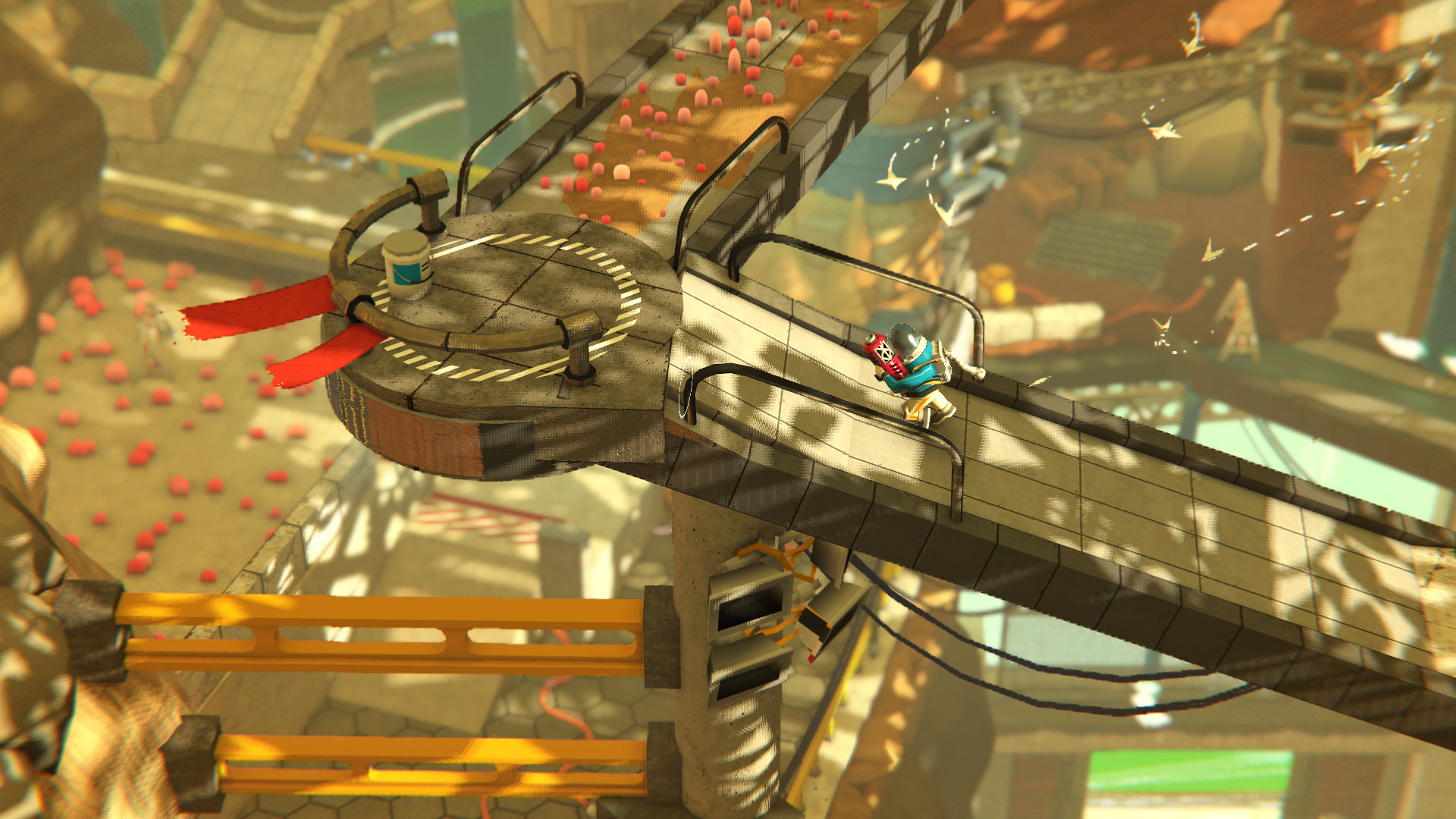
At first it’s exhilarating to line up your shots, such that your enemies will flail helplessly across the screen to their impending doom, exploding into chunks of blood upon landing in a saw blade. It’s not overly gory, thanks to Radio Viscera’s affable aesthetic but feels brutal nonetheless. Unlike our hero, the standard foes carry guns with bullets, but a quick air cannon shot to the sternum knocks their weapon out of their hands. From there, you can go camp beside it and wait to blow them away as they frantically dart across the room in a miserable bid to retrieve their gun.
Your accuracy doesn’t have to be spot on either, which certainly works in the game’s favour. Each hazard seems to possess its own gravitational pull, so it’s a case of close enough is good enough, which helps maintain the frantic momentum that makes twin-stick shooters a joy. However, whilst the opening levels are great fun, the further you progress, the more cracks appear in Radio Viscera’s foundations, some of which stem from the concept itself.
The game struggles immensely with implementing variety to proceedings, though it desperately wants to provide some. This can be seen in how later levels introduce additional enemy types designed to force you to alter your tactics, but instead, only serve to stall the flow of the game. There are these heavily armed foes that roll up into a ball like a pill bug whenever you shoot at them. Not only does this limit how far you can knock them back, but their stubborn shells also grant them immunity from some hazards. This results in fairly tedious segments where you gradually push them towards something powerful enough to penetrate their armour.
Lacking ideas
Since the original premise is so one-dimensional, the developers could only sprinkle in variety using different enemy types. But the more variants it includes, the further Radio Viscera moves away from the simple satisfaction that makes the early stages a delight. Sure, additional hazards also appear, but ultimately they’re just another giant saw blade with an alternative presentation. The penultimate level has some success with a segment that feels pinball-esque in its execution, but at that point, most people will have moved on.
The attempts at mixing things up might not feel so unsuccessful if everything wasn’t marred further by several technical issues. The camera is, frankly, nauseating. Even with camera shake switched off in the options menu, it would still swing around wildly at times, making anyone with motion sickness feel woozy. On top of that, I fell off the map and died on multiple occasions, which, considering your score gets reset to zero upon death, was a tad irritating.
There is a reasonable game lurking somewhere inside Radio Viscera. The early knockings were enough to show me that there is a lot of fun to be had with this concept. However, the attempts at including variety often miss the mark, and a string of technical problems exacerbate the game’s shortcomings. It is certainly a novel attempt to subvert the genre, but, ultimately, it falls incredibly short. Instead, it makes me yearn for a more traditional twin-stick shooter, even if that would offer no surprises.